 Ernster, the Virtual Library Cat
Saturday, January 21, 2006
Law School and Beyond--Facts and Figures About Legal Education
Have you ever wanted to find a list of specialized post-J.D. degree programs offered by American law schools? Did you ever need some reliable facts and figures about legal education for a research paper, presentation or special event? A great source of quick and authoritative information is the American Bar Association’s Section of Legal Education and Admissions to the Bar. Their web site’s Legal Education Statistics page provides links to the latest law school enrollment figures, and to statistics on student and faculty demographics, law school tuition and living expenses, and much more. Select other links to view listings of post-J.D. programs in a wide variety of specialties, from tax law to tribal law, with a definition of the legal degrees conferred. Those interested in the financial impact of their career choices, especially in the light of law student debt, might want to scroll down under “Latest News” on the Section’s home page for the link to the “Report of the ABA Commission on Loan Repayment and Assistance.” This report highlights recent data on student debt patterns, lawyer starting salaries, and the impact of both on law school graduates and the communities they serve.
Ernster, the Virtual Library Cat
Ernster, the Virtual Library Cat


Friday, January 20, 2006
Happy Belated 300, Ben!
I could not let the week go by without wishing Benjamin Franklin a happy 300th birthday (which was Tuesday, January 17). As a "founding father", his credentials are unassailable. Franklin signed the Declaration of Independence, took the lead in negotiating military assistance from France and the peace treaty at the end of the Revolutionary War and was part of the Constitutional Convention. In his "spare time", he was also one of the foremost scientists and publishers of the age. He prized tolerance and had a reputation for a wicked sense of humor.
How could you not want to celebrate someone who was described as "equal parts Franklin Delano Roosevelt, Ronald Reagan and Bugs Bunny" ?
(Quoted from op-ed piece in Tuesday's New York Times by Stacy Schiff, the Pulitzer Prize-winning author of A Great Improvisation: Franklin, France and the Birth of America .)
Ernster, the Virtual Library Cat
How could you not want to celebrate someone who was described as "equal parts Franklin Delano Roosevelt, Ronald Reagan and Bugs Bunny" ?
(Quoted from op-ed piece in Tuesday's New York Times by Stacy Schiff, the Pulitzer Prize-winning author of A Great Improvisation: Franklin, France and the Birth of America .)
Ernster, the Virtual Library Cat
Thursday, January 19, 2006
Coalition of Journalists for Open Government
The Web site for the Coalition of Journalists for Open Government is an online resource provided by this organization, whose primary goal is to improve public access to records and meetings at all governmental levels, and to strengthen laws that will make government more transparent. The home page offers listings of linked “headlines” that consist of excerpted news stories, articles and other items. Many of the excerpts include links to other relevant material, such as the texts of bills. In addition, the Coalition posts its various position papers, petitions, and letters to the site
Ernster, the Virtual Library Cat
Ernster, the Virtual Library Cat
Wednesday, January 18, 2006
Don't forget your IDs
Since it is an important issue, we're going to repeat the recent email sent out to the law students.
All students: Please remember that, for security purposes, your Hofstra ID is required for entrance to the law library. We understand that some of the public safety guards have worked here for many years. During this time, they have come to recognize the faces of frequent users, and they may not request an ID each time these individuals enter. However, it is important to note that we do not always have the same public safety guards and many of them may not recognize law student faces. Therefore, any public safety guard may request an ID from any student who enters the law library, and students must comply with this request.
Thank you for your cooperation.
Ernster, the Virtual Library Cat
All students: Please remember that, for security purposes, your Hofstra ID is required for entrance to the law library. We understand that some of the public safety guards have worked here for many years. During this time, they have come to recognize the faces of frequent users, and they may not request an ID each time these individuals enter. However, it is important to note that we do not always have the same public safety guards and many of them may not recognize law student faces. Therefore, any public safety guard may request an ID from any student who enters the law library, and students must comply with this request.
Thank you for your cooperation.
Ernster, the Virtual Library Cat
Tuesday, January 17, 2006
Wall Street Journal's Law Blog
The Wall Street Journal launches a blog devoted to law and business and the business of law. This should be an interesting blog to watch for those of us who like to get the WSJ's take on legal matters.
Ernster, the Virtual Library Cat
Ernster, the Virtual Library Cat
Monday, January 16, 2006
Hofstra Law Professor Nora Demleitner at Alito Hearings
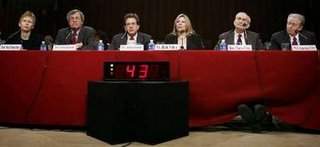
Hofstra Professor Nora Demleitner (on left) appeared before the Senate Judiciary Committee to testify at the confirmation hearing of U.S. Supreme Court nominee Samuel Alito January 13, 2006. Professor Demleitner clerked for Judge Alito from 1992-1993. She recently appeared as a guest columnist for JURIST, writing a piece entitled Why Feminists and Liberals Have Nothing to Fear from Judge Alito. Full text of her testimony can be viewed here via the New York Times.
Ernster, the Virtual Library Cat
Saturday, January 14, 2006
A Virtual Path to Martin Luther King's World
With this Monday’s holiday in mind, your Virtual Library Cat has been nosing around computer screens hoping to peer into some authoritative and fascinating MLK web sites. The basics about the MLK Holiday (click on the word "here" at the bottom of this page) and how it came to be celebrated nationwide are provided by the King Center. Established in 1968 by the civil rights leader’s widow, Coretta Scott King, the King Center is the “living memorial and institutional guardian of Dr. Martin Luther King, Jr.’s legacy.” To discover Dr. King’s life and work through direct immersion in photos, letters, sermons, speeches, and links to information about nearly every person associated with him and his movement, there is no better online source than the King Papers Project. A cooperative venture of Stanford University, the Center, and the King Estate, the Project’s primary mission is to publish a definitive 14-volume edition of King’s written works, the Papers of Martin Luther King, Jr. Five volumes have already been completed, with digitized transcripts of many documents available online. Dynamic use of these documents is made in the site’s Major King Events Chronology and in the impressive King Biography and King Encyclopedia, with internal links to any major idea, activity or personality of the civil rights movement as well as to King’s own writings.
Ernster, the Virtual Library Cat
Ernster, the Virtual Library Cat
Friday, January 13, 2006
Unitary Executive and Legislative History
This week's hearings on Judge Alito's confirmation has provided an interesting confluence between an issue in the news (the unitary executive theory) and legislative history research.
Several of the Democratic senators pressed Judge Alito on his view of this unitary executive philosophy, held by President Bush. Their concern arises from the fact that President Bush has, possibly over 100 times, expressed his intention to interpret Congressional legislation in light of this unitary executive viewpoint. How does all of this relate to legislative history research?
These expressions from President Bush are found in the Presidential signing statements (found in the Weekly Compilation of Presidential Documents). When presidents sign bills passed by Congress into law, they frequently issue a statement. President Bush has adopted the practice of stating his interpretation of the law in those statements (a practice believed to have started with President Reagan.) This has become particularly controversial very recently in light of the passage of the "McCain amendment" regarding treatment of detainees. In his signing statement for that law , President Bush invokes the unitary executive notion and discusses, in some detail, how the executive branch will interpret the law. (See the discussion of Title X on p. 1919 for the President's statement regarding treatment of detainees.) There is considerable debate as to whether any President can affect the interpretation of laws in this fashion.
So, the next time you cringe when you have a legislative history project, remember it can have some very real, and fascinating "hot topic" implications.
Ernster, the Virtual Library Cat
Several of the Democratic senators pressed Judge Alito on his view of this unitary executive philosophy, held by President Bush. Their concern arises from the fact that President Bush has, possibly over 100 times, expressed his intention to interpret Congressional legislation in light of this unitary executive viewpoint. How does all of this relate to legislative history research?
These expressions from President Bush are found in the Presidential signing statements (found in the Weekly Compilation of Presidential Documents). When presidents sign bills passed by Congress into law, they frequently issue a statement. President Bush has adopted the practice of stating his interpretation of the law in those statements (a practice believed to have started with President Reagan.) This has become particularly controversial very recently in light of the passage of the "McCain amendment" regarding treatment of detainees. In his signing statement for that law , President Bush invokes the unitary executive notion and discusses, in some detail, how the executive branch will interpret the law. (See the discussion of Title X on p. 1919 for the President's statement regarding treatment of detainees.) There is considerable debate as to whether any President can affect the interpretation of laws in this fashion.
So, the next time you cringe when you have a legislative history project, remember it can have some very real, and fascinating "hot topic" implications.
Ernster, the Virtual Library Cat
Thursday, January 12, 2006
Treaty Status On Thomas
A somewhat well-kept secret is the fact that information is available on Thomas regarding the status of treaties to which the U.S. is a party. Complete coverage begins with the 94th Congress (1995-96). Older treaties are included if they were pending in 1975 when the database was created. Users may search by Congress, by word/phrase, by treaty number, or even by treaty type. There are also links to GPO Access for those who require the full text of treaties from the 94th Congress forward.
Ernster, the Virtual Library Cat
Ernster, the Virtual Library Cat
Wednesday, January 11, 2006
Painting the Library
Starting this week, and continuing for at least through next week, the walls of the first floor of the Library are being painted. The work will be done during closed hours, but you will see pictures and signs being moved around as the painters do their work. We thank you for your patience during this time.
Ernster, the Virtual Library Cat
Ernster, the Virtual Library Cat
Subscribe to:
Posts (Atom)


